JAKARTA: A massive restructuring of the Indonesian Military (TNI) has raised concerns among observers over its inefficient use of the defence budget and further militarisation efforts across the country, warning of the growing military presence in civic spaces.
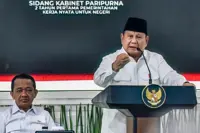
On Sunday (Aug 10), President Prabowo Subianto presided over a ceremony in Batujajar, West Java to inaugurate dozens of new units in the military. The event was attended by top government officials, including Vice President Gibran Rakabuming Raka, House of Representatives Speaker Puan Maharani, Defence Minister Sjafrie Sjamsuddin and top military officers.
At the event, Prabowo formally established six new regional commands of the Army, 14 of the Navy and three of the Air Force. He also created one air operations command, six groups of the Army’s Special Forces (Kopassus), 20 territorial development brigades, 100 territorial development battalions, five infantry battalions for the Navy's Marine Corps and five commando battalions for the Air Force's Rapid Force Corps (Kopasgat), among others.
The President said the expansion was necessary to bolster national defence, amid global instability emanating from ongoing wars in Europe and the Middle East.
“A big nation like us needs a strong military. No nations can be independent without having a strong military,” Prabowo said in his speech on Sunday, adding that Indonesia “must strengthen our defence to protect our sovereignty and resources”.
Sunday’s ceremony also marked a significant organisational shift as Prabowo appointed Gen. Tandyo Budi Revita as TNI deputy commander, the first to hold the position in over two decades. The post was scrapped in 2000 but was revived by then-president Joko “Jokowi” Widodo in 2019.
Prabowo also upgraded the ranks of the commanders of elite forces across all branches, the Kopassus, the Marine Corps and the Kopasgat, from a two-star position to a three-star general position.
The upgrade came on the heels of dozens of promotions in TNI’s ranks on Aug. 6 and marked a massive restructuring of the institution under Prabowo, who has shown growing reliance on the military to help deliver his administration’s priority programmes since he assumed office late last year.
The overall restructuring has drawn mixed reactions from observers, some of whom have deemed it “important” to modernise the institution while others questioned its effectiveness.
Military analyst Rizal Darma Putra of the Indonesia Institute for Defence and Strategic Studies (Lesperssi) said the expansion would lead to higher operational costs and did not align with Prabowo’s cost-cutting efforts.
“This is not an investment. It is simply an organisational expansion that will cost a lot without necessarily making the military more effective,” Rizal said, adding that the government should instead invest in high-tech warfare capabilities and weaponry. He saw the restructuring as less of a carefully planned modernisation strategy and more of “a pragmatic policy to absorb the surplus of military officers”.
Al Araf of human rights group Imparsial said that the expansion signals a return to an “inward-looking” defence, focussing more on domestic threats compared to regional ones. “Adding six new regional military commands strengthens a structure rooted in the New Order’s dwifungsi [dual function] doctrine, which reform-era laws sought to reduce, not expand," he said.
Al Araf was referring to the military’s system under former president Suharto’s authoritarian regime that granted the military significant influence over civilian affairs and led to dozens of human rights violations.
Human rights activists have pointed toward the military’s growing presence in the civil sector during Prabowo’s administration, more so after the controversial amendment to the TNI Law in March.
Rizal of Lesperssi feared that the establishment of new regional military commands meant it would focus on “intelligence” functions that would subtly oversee local administrations.
TNI spokesperson Maj. Gen. Kristomei Sianturi did not immediately respond to The Jakarta Post’s request for comments. He previously defended the restructuring, saying that the military had “meticulously calculated” the budget needed for the expansion and that not all new units would need new recruits, Antara reported.
Military analyst Khairul Fahmi of the Institute for Security and Strategic Studies welcomed the restructuring, noting that the promotions and the expansion would help increase the military’s swiftness against future threats. “Promoting the commanders of the military’s elite forces to a higher rank [...] will enable them to have a more effective cross-service coordination,” Khairul said on Sunday. - The Jakarta Post