




King crab is a favourite of Hong Kong seafood lovers, as long as they do not have a reaction to the delicacy, which was among six types of shellfish found to contain eight newly identified allergens.
A study led by Chinese University of Hong Kong academics looked at six types of crabs popular with local diners and found 11 allergens, including eight identified for the first time.
Revealing their findings, the researchers said that a more precise diagnosis would allow patients to consume crabs to which they were not allergic.
“Crabs are one of the most important types of shellfish that cause allergic reactions,” said Leung Ting-fan, a paediatrics professor at the university.
Crabs are the second largest cause of food allergy among Hong Kong pupils aged six to 11 after shrimp, affecting around 0.2 per cent of them, according to research published in 2020.
Crabs are a delicacy in Hong Kong, especially the most expensive king crabs, which can cost at least HK$1,800 for one weighing 2.5kg. The best season for king crabs is considered winter, with ones sourced from the cold waters of Alaska, Russia and Hokkaido in Japan highly prized.
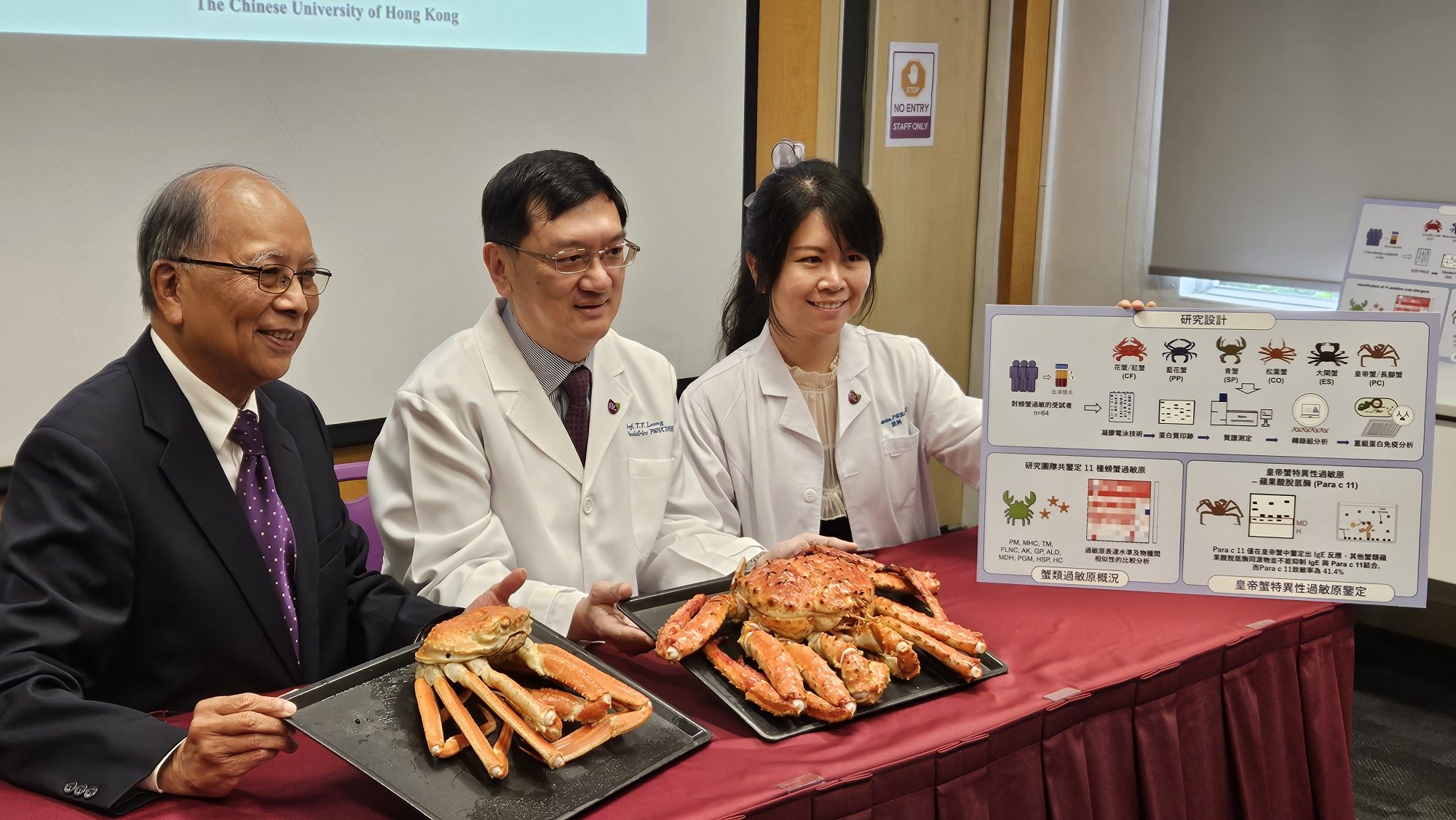
In the latest study, researchers collected blood samples from 64 subjects who have reported an allergy to crabs. The samples were tested for allergic reactivity with different substances extracted from five locally procured edible crabs – snow crab, flower crab, hairy crab, crucifix crab and green mud crab. The king crab was also included.
King crabs are not considered “true crabs”. They are closely related to hermit crabs and are considered “false crabs” due to their evolutionary lineage and anatomical features.
Professor Chu Ka-hou, a professor emeritus at the university’s life sciences school, said the king crab evolved from different ancestors. “Therefore, its biological protein structure is different from that of true crabs,” Chu said.
A key difference was that king crabs only had eight legs, but others had 10, he said.
Eleven allergens were found across the six types of shellfish, with eight being newly identified. The team also found that different crabs displayed different combinations of allergens.
The findings were published in a recent edition of the peer-reviewed journal Allergy and presented at two international academic conferences.
“If we can understand different [allergy] patterns of different patients, we can help them hopefully avoid crabs that they are allergic to, while they can enjoy other crabs that don’t have such allergens,” Leung said.
While different crabs contain various sets of allergens, shellfish parts may also play a role.
Mercy Chow Man-ching, 17, has been allergic to various types of fish, but not crabs or shrimp, since the age of one. However, two months ago, about 10 minutes after eating some raw crab and crab roe in South Korea, Chow displayed acute allergic symptoms.
“I felt my throat swelling and I was dizzy. My lips were swelling, too,” she said.

Chow took anti-allergy pills and saw a doctor back in Hong Kong. A check found her blood had reacted to haemocyanin, an allergen identified in the study that is commonly found in crab roe.
Doctors said eating crab roe could have been a reason for her acute symptoms, pending further investigation.
The research findings would also contribute to the development of differentiated allergen reagents, Leung said. Currently, most reagents only target allergens in snow crabs.
“Current reagents may not be as effective in testing allergens in other crabs, leading to ‘fake negatives’,” he said.
The study also revealed a king crab-specific allergen, malate dehydrogenase. While the substance could be found across the six shellfish surveyed and even in the human body, only that extracted from king crabs would lead to an allergy.
“We have yet to identify why it has such a large difference, but we can tell this reactivity is specific [to king crab],” said Dr Christine Wai Yee-yan, a research assistant professor of paediatrics at the university. -- SOUTH CHINA MORNING POST


