




Ancient “lamp shells” – bottom-dwelling invertebrates that once ruled the oceans – may have used hundreds of bristle-like structures to “social distance” in a bid to improve their chances of survival, Chinese palaeontologists have discovered.
Their findings are based on a fossilised species of brachiopods – or clam-like marine animals – that was discovered in China’s southwestern Guizhou province.
The fossils, discovered embedded in rocks, were found to be arranged in a “checkerboard-like” pattern across what was once the sea floor.
Individuals of the extinct species Nucleospira calypta were likely to have used the flexible bristle-like structures – thinner than human hair – to help guide their movement and arrange their population to provide adequate space for filter feeding.
“We report exceptionally preserved soft, bristle-like structures (“setae”) on 436-million-year-old brachiopods, enabling analysis of ancient behaviour,” the team said in a paper published in the peer-reviewed journal Proceedings of the National Academy of Sciences on July 21.
Using advanced imaging and spatial analysis, the researchers determined that Nucleospira calypta formed a “highly regular” pattern of spacing that corresponded to about 1.5 to 2 times the length of their setae.
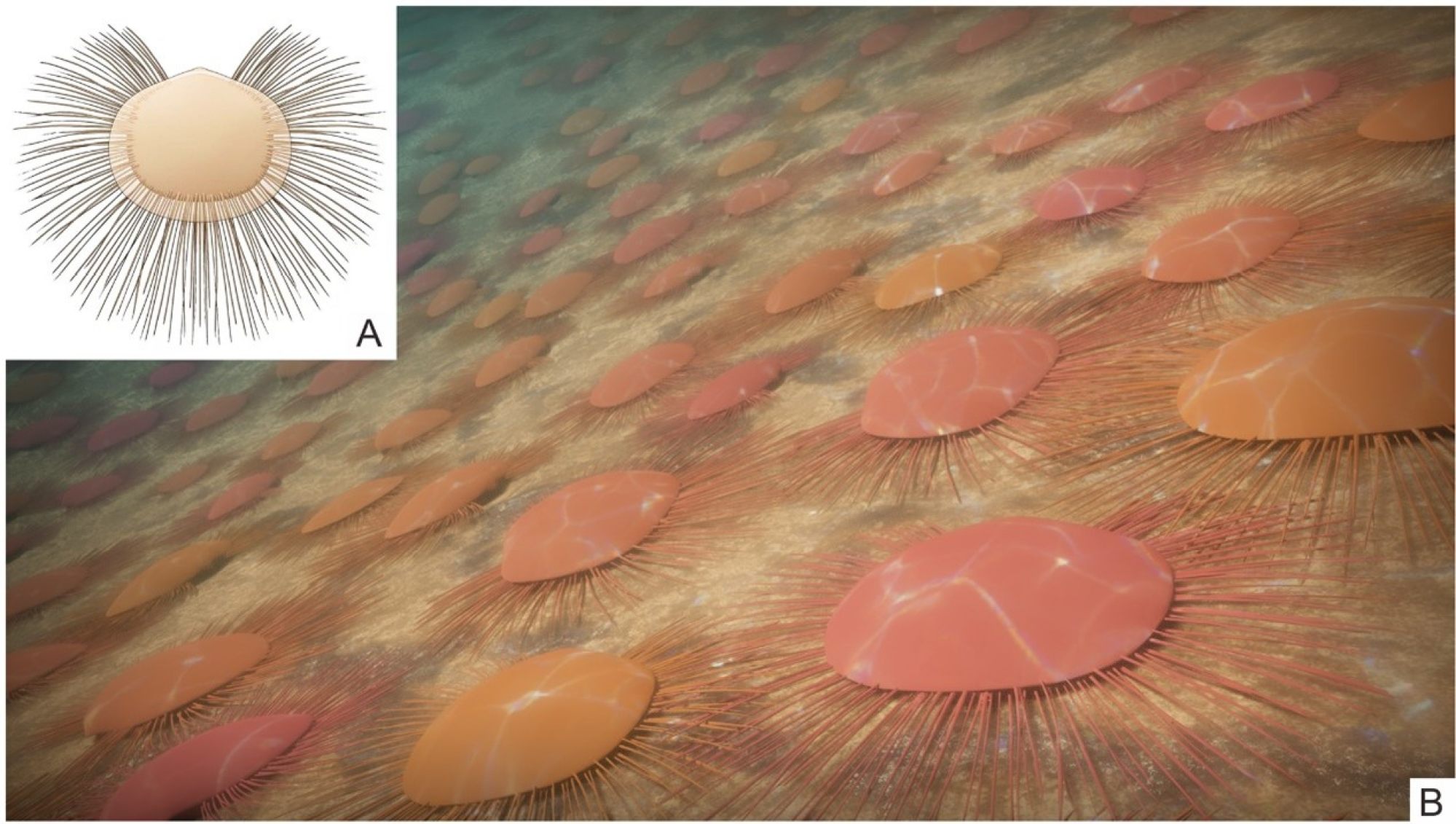
“Our findings point to a previously unrecognised mechanism shaping ecosystem structure in deep time,” said the researchers from the Chinese Academy of Sciences’ (CAS) Nanjing Institute of Geology and Palaeontology.
“This is the first time we’ve directly connected a specific anatomical feature – these tiny setae – to a statistically significant spatial pattern in fossils,” study authors Huang Bing and Rong Jiayu told CAS.
Brachiopods were the most diverse and common marine organisms during the Palaeozoic era (541 to 251 million years ago), according to the Smithsonian Museum of Natural History.
There are 30,000 known brachiopod species based on fossil records, but fewer than 400 are alive today, and they are found in very cold waters in the polar regions or the deep sea.
Also called lamp shells due to their resemblance to ancient Roman oil lamps, some species of brachiopods have setae, which grow from the edges of the mantle – a vital tissue layer also found in molluscs.
“Brachiopod setae, hypothesised to function in feeding or defence, are exceedingly rare in the fossil record,” the team said.
“For filter-feeding brachiopods reliant on suspended plankton, dense aggregations could disrupt essential feeding currents, analogous to spacing optimising light capture in plants”.
The “exceptionally well-preserved” fossils analysed by the researchers belong to the early Silurian period, around 444 to 419 million years ago.
Adults of the Nucleospira calypta species found in the Hanchiatien geological formation in Guizhou had about 200 to 250 setae in total.
The length of each typically ranged from 3mm to 8mm (0.12 to 0.3 inch), with a diameter less than a third that of a single human hair.
The team determined that the setae were so well preserved because they were first rapidly mineralised by pyrite in oxygen-free waters, and then coated in calcite when ocean conditions became less acidic.
This double coating of minerals shielded the delicate bristles from decay and being crushed.
Spatial analysis revealed that the fossilised brachiopods were not randomly scattered, but rather had a “statistically significant, nonrandom, checkerboard-like distribution” across the rock.
“Such a pattern is characteristic of territorial behaviour or resource competition,” the researchers said.
“Strikingly, the measured average inter-individual spacing quantitatively relates to the length of the preserved setae”.
The Nucleospira calypta species lacked a pedicle, a stalk-like structure that can help marine animals anchor to the sea floor.
They also had a smooth and flat circular shell, which the researchers said possibly allowed them to slide on the ocean floor millimetre by millimetre.
When individuals would get too close, their setae would touch, which was likely to have prompted them to make gradual adjustments to their positioning, according to CAS. -- SOUTH CHINA MORNING POST


