BANGKOK: Thailand picked a rate-cut advocate with close ties to the government as its next central bank governor, defying concerns over a potential erosion of the monetary authority’s independence.
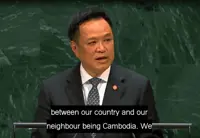
The cabinet approved the nomination of Vitai Ratanakorn (pic), as proposed by Finance Minister Pichai Chunhavajira, during a weekly meeting in Bangkok on Tuesday (July 22), according to government spokesman Jirayu Houngsub.
The president of the Government Savings Bank was chosen over fellow finalist and Bank of Thailand deputy governor Roong Mallikamas.
Vitai’s cabinet endorsement was based on his "knowledge, expertise, and experience in economics and banking, and that he meets the qualifications prescribed by law,” Jirayu said.
The decision was delayed last week when the cabinet did not discuss the proposal due to incomplete paperwork.
This caps off a months-long BOT governor race that has been marred by concerns about the government encroaching on the central bank’s autonomy as it repeatedly presses for lower interest rates to boost the economy.
Similar tensions are brewing elsewhere with US President Donald Trump publicly deriding Federal Reserve Chair Jerome Powell and even discussing his possible removal in a quest for deeper rate cuts.
The baht was up 0.2% versus the dollar at 32.28, while the Thai 10-year yield is down 1 basis point at 1.50% as the currency and bond held into gains following the BOT announcement.
The 54-year-old Vitai is seen as a proxy candidate of the Finance Ministry. During his tenure as the head of the state-owned GSB, he led government efforts to provide financial relief to small businesses and households who borrowed heavily during the pandemic.
Vitai’s selection signals the government’s support for a candidate who has advocated for more aggressive easing to shore up a faltering economy and ease the burden on borrowers saddled with record debt.
He has also called for closer coordination between fiscal and monetary policymakers, which could mean a break from the stance of incumbent Governor Sethaput Suthiwartnarueput, who has resisted calls for rate cuts and a higher inflation target.
The government earlier attempted to install its own nominee as BOT chair, but it was opposed by former Thai central bank chiefs and economists.
Vitai faced similar criticism, with an ex-BOT governor saying he wouldn’t be able to make independent decisions because of his ties to the government.
A group of academics also posted an open letter on Monday, saying the one with central banking experience should be the most appropriate for the job.
Vitai defended himself in a Facebook post on July 8, saying: "My experience and strong self-identify offer the confidence that I can make decisions independently, based on principles. Seeking the best interest of the country is important, without being influenced by any group.”
The incoming governor faces a challenging economic landscape, including the region’s highest household debt, sluggish credit demand, negative inflation and weakening consumption. His five-year term is set to begin on Oct 1, pending royal endorsement as required by the Thai central bank law.
Despite a cumulative 75-basis point reduction in borrowing costs since October, growth remains subdued, further threatened by punitive US tariff on Thai exports and a slowdown in foreign tourist arrivals - both critical drivers of the economy.
The policy rate should be significantly lowered for a sustained period to revive the stagnant economy, Vitai told local media last month after applying for the governor’s role. More importantly, though, commercial banks must also pass on the reduction to customers.
"This is a deep and prolonged downturn, and while interest rate cuts are necessary, they are not enough. Additional supportive measures are required,” the Bangkok Post reported, citing Vitai on June 23.
Although interest rates are decided by majority vote, Vitai, as the head of the policy panel, is expected to have influence over its direction. Vitai will chair the Monetary Policy Committee for the first time on Oct 8. The next scheduled meeting of the committee is on Aug 13.
The central bank last month left the benchmark interest rate unchanged at 1.75%, citing the need to preserve limited policy space to respond to future shocks.
"The job at hand for the incoming governor will be to ensure that market participants perceive his policies as independent and based on economic fundamentals,” said Lavanya Venkateswaran, an economist at Oversea-Chinese Banking Corp. in Singapore.
"Notwithstanding, we expect the BOT to remain dovish in its bias and have another 50 basis points in rate cuts for the remainder of this year.”
As the chief of the Government Savings Bank, which was established in 1913 by King Rama VI, Vitai has managed its more than 3 trillion baht (US$92 billion) of assets since 2020. Tasked to be a "social bank” that focuses on development returns instead of profitability, GSB has been the government’s key tool in extending hundred billions of soft loans to vulnerable groups.
Vitai holds master’s degrees in finance from Drexel University in Pennsylvania, and in law and political economy from Chulalongkorn University in Bangkok. As a son of Siriluck Ratanakorn, the first female head of the Stock Exchange of Thailand during 1982-1985, he started trading stocks since high school.
Vitai positioned himself as a "change leader” who could turn around organisations. His past experience includes serving as the chief financial officer at debt-ridden Nok Airlines as well as acting president at the Islamic Bank of Thailand.
"I like challenges and I like a tough job,” he said in a interview VDO clip with local media the People in 2022.
"I think I am suitable for the job of rehabilitating, changing strategy and re-positioning of an organisation. It will be fun if we can do that.” - Bloomberg