
SINGAPORE (The Straits Times/ANN): The DNA of six endangered fish species was found in fish maw products from stores in Singapore and Malaysia, a new study found.
This was uncovered by a pair of researchers from the National University of Singapore (NUS) and Universiti Malaysia Terengganu (UMT), who analysed the DNA of 480 samples of fish maw. The duo published their research on June 24, in the journal Conservation Letters.
Fish maw – a delicacy in Chinese cuisine – is derived from the dried swim bladder of fish. Also known as the air or gas bladder, the organ helps fish modulate their buoyancy, allowing them to remain at a desired depth without floating or sinking.
Widely consumed throughout much of East and South-East Asia, fish maw is regarded as an indicator of wealth, prestige and status in Chinese culture. It is also a popular ingredient in stews and soups, as it brings purported health benefits.
The mysterious origins of fish maw
He said: “Fish maw has been processed, flattened, cleaned and washed.
“You can’t determine what species the maw comes from without using genetic methods – so we have no idea of what species are involved in this trade in South-East Asia.”
The aggregation of fish maw and other dried fish products under a common commodity code has also made its trade harder to oversee.
Prof Wainwright said: “Commodity codes are meant to say, this is shark fin, this is shrimp, this is fish maw – but at the moment, all these products are lumped together and imported as dried fish goods.”
Thus, the two researchers – Dr Seah Ying Giat of UMT and Prof Wainwright – set out to collect fish maw samples from stores in Malaysia between October and December 2023, and in Singapore from January to April 2024.
Within the Republic, they visited dried goods shops such as those in Victoria Wholesale Centre and Albert Centre, Prof Wainwright said.
“Just from walking around Chinatown, you can see maw everywhere – sold in lots and lots of shops. In supermarkets, there’s fried maw all over the place as well.”
DNA was successfully analysed from 118 samples from Malaysia and 362 samples from Singapore, and a total of 39 fish species were identified across both countries.
The dried fish maw products sampled in Singapore ranged from $80 to $1,184 per kilogram, the researchers found.
The most commonly identified species was the blackspotted croaker (Protonibea diacanthus), which made up 58 of the 480 samples.
It is classified as near threatened on the International Union for Conservation of Nature (IUCN) Red List, which outlines the conservation status of animals, plants and fungi. This means that though the species is currently not threatened by extinction, it is likely to become endangered in the near future.
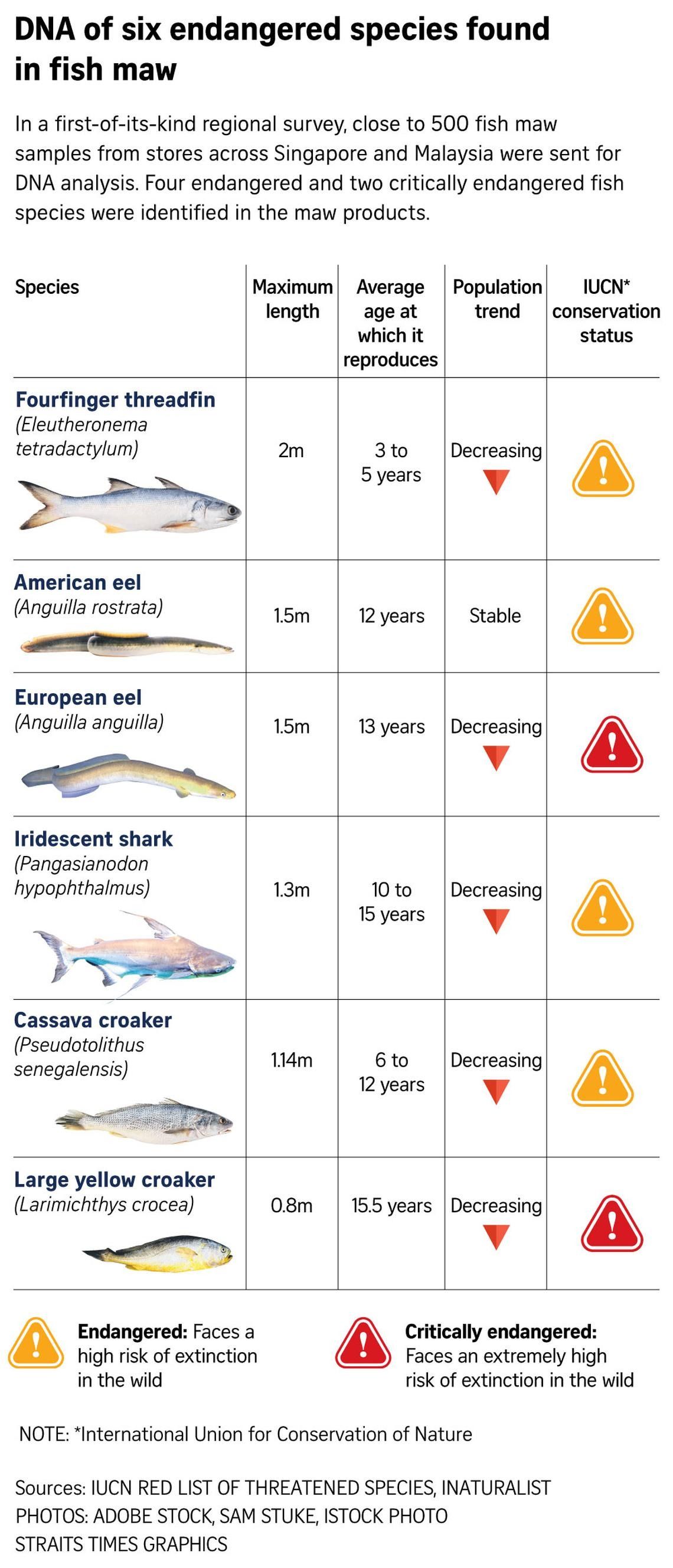
Among the species identified from the maw samples, there were also four endangered and two critically endangered ones on the IUCN Red List.
The endangered species identified were: the cassava croaker (Pseudotolithus senegalensis), American eel (Anguilla rostrata), fourfinger threadfin (Eleutheronema tetradactylum) and iridescent shark (Pangasianodon hypophthalmus).
Maw samples were also found to originate from the large yellow croaker (Larimichthys crocea) and European eel (Anguilla anguilla), which are critically endangered.
Notably, 11 samples of fish maw were identified as coming from the European eel, despite the European Union’s enactment of a zero-export quota on the fish in 2010, which bars its export from the region.
On this, Prof Wainwright said: “It’s not that surprising that eel maw has been sold, because you can find the eels here.
“But it’s interesting that the European eel is still making it here, because that should have been banned a long time ago.”
Consider more sustainable alternatives
Ultimately, as fish maw products often do not specify the exact species used, it may be difficult for consumers to make informed choices, said Mr Chester Gan, the marine lead at the World Wide Fund for Nature (WWF) Singapore.
Businesses and corporations thus play a vital role, he added, and should examine their supply chains to ensure they are sourcing ingredients responsibly and reducing environmental impact.
He said: “Given that fish maw may originate from fisheries with little data, endangered species, or unsustainable fishing practices that harm vulnerable marine life, we urge both consumers and businesses to consider more sustainable alternatives.”
To Prof Wainwright, the best option is to not consume fish maw, especially if its species, country of origin and the sustainability of the fishery it is from cannot be confirmed.
He said: “The hope is, as more people become aware of the damage caused by unsustainable fishing, they may turn away from products of unknown origin and towards seafood from sustainable fisheries.
“Otherwise, when a species targeted for fish maw gets fished out, it’s very likely we’ll turn to another species and fish that one out, and then do the same for the next ones.” - The Straits Times/ANN