
The envoys of the world’s two leading powers painted starkly different pictures of US-China ties, each offering a competing assessment of the state of their economic relations – as a recently agreed framework to ease trade tensions hung in limbo.
Speaking at the US-China Business Council in Washington on Wednesday, Chinese ambassador Xie Feng called the trade relationship “generally balanced” and tariffs on Chinese imports “still unreasonably high”, warning that the US goods deficit would not shrink while export controls, visa denials, and barriers to Chinese firms persist.
“We are willing to buy more from America,” Xie said, adding that “unfortunately” the US had imposed “strict restrictions on the exports of its most competitive products, such as semiconductors, and shut the door on Chinese enterprises, buyers, tourists and students who want to invest and spend in the US”.
“If one is reluctant to sell others what they want, how can it ever get its deficit reduced by exporting only products like soybeans and beef?”
Since 2022, the US has steadily tightened restrictions on China’s access to American technology over concerns it could fuel military advancements. These curbs intensified under US President Donald Trump’s second term.
However, earlier this month, the US agreed to ease some restrictions and allow Chinese students unhindered access to American universities in exchange for increased exports of critical minerals from China.
Talks between the two sides in London produced a framework to implement the trade consensus reached in May in Geneva regarding Trump’s new tariffs on Chinese imports – now reduced from 125 per cent to 55 per cent.
Xie said the current US tariffs on China were “still unreasonably high, will severely constrain and undercut bilateral trade and should be removed completely”.
He added that it was “unrealistic to try to block the flow of capital, technology and talents in a globalised world, if any country builds up barriers, these resources will naturally flow elsewhere”.
Since June last year, the China-US trade has dropped by 8 per cent, while China’s trade with the Association of Southeast Asian Nations and EU countries grew by 9 per cent and 3 per cent, respectively compared to the same period last year.
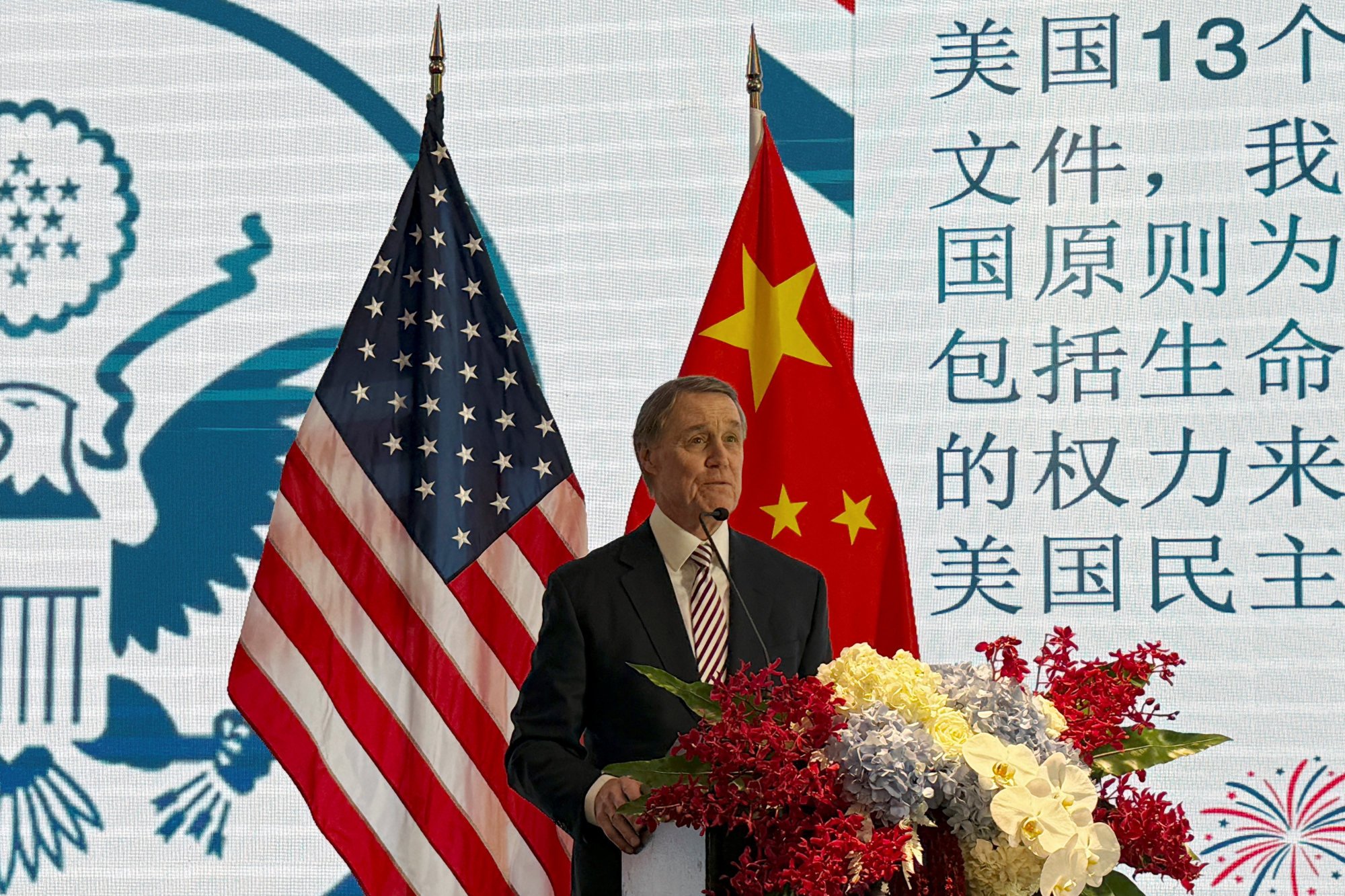
Meanwhile, David Perdue, America’s newly posted ambassador to Beijing, said that trade should be a means by which sovereign nations provide benefits to their citizens, “not an ideological goal to be pursued in favour of transforming the world”.
He added that Trump’s vision was to have a trading relationship with China based on reciprocity, fairness and respect, “one of which the United States puts the American people first, just as China does for its own people”.
“Our mission in China is to do everything we can to make that vision happen and to make America safer, stronger and more prosperous,” Perdue emphasised, blaming unfettered globalisation for making US business “overly dependent” on China for components, inputs, intermediate goods and even entire supply chains.
“Our economy cannot be so dependent on foreign supply chains that can be severed at any moment,” he said.
Addressing US businesses’ concerns about losing the Chinese market due to strained bilateral relations, Perdue said that the administration understands the “risk of change” and “we will be there to support you and protect you from unfair practices”.
However, Xie urged the US to “look at the whole picture” to see that “the benefits our two countries have taken from bilateral trade are generally balanced”.
“Any selective reading of the statistics would be misleading,” he added.
Xie said that focusing only on goods trade overlooked the US surplus in services, American firms’ strong revenues in China, the heavy environmental and resource costs China has borne, and the fact that the “Chinese people have chosen to spend much of the trade gains buying a large amount of US Treasury bonds”.
After Japan and Britain, China is the third-largest holder of US Treasuries – government debt securities used to finance federal spending.
In December last year, China’s holdings fell to US$759 billion, the lowest level since February 2009, when they stood at US$744.2 billion. By March, China had slightly reduced its holdings again, to US$765.4 billion.
The senior officials’ remarks came weeks after the latest US-China trade talks in London. The meeting was believed to focus on semiconductors and critical minerals, areas in which Washington and Beijing hold significant leverage over each other, respectively.
Yet neither Beijing nor Washington has released an official readout of the dialogue since the negotiations ended, hinting at considerable uncertainty.
Delegations from both sides said the trade agreement would require approval from their leaders, US President Donald Trump and Chinese President Xi Jinping.
Shortly after the negotiations, Trump on social media said a deal with Beijing was “done”, adding that China would supply full magnets and any necessary rare earths “up front”.
Beijing has yet to issue a comprehensive response regarding its take on the talks, nor has Xi commented on them publicly.
Meanwhile, US investor sentiment towards China has declined sharply.
According to a survey last month by the China General Chamber of Commerce-USA, nearly half of the more than 100 Chinese companies who responded said they planned to reduce their investment in the US.
The shift was also evident last month at the Commerce Department-backed SelectUSA Investment Summit, where only about 50 Chinese delegates attended, down from roughly 180 in 2018.
Xie’s remarks also came against the backdrop of escalating tensions between Israel and Iran.
The Jewish state last week launched air strikes on the Islamic Republic, targeting Iranian nuclear facilities amid ongoing nuclear talks between Washington and Tehran.
Israel’s strikes have led to the deaths of multiple Iranian army heads and nuclear professionals.
In retaliation, Iran carried out air strikes against Israel, causing casualties in Tel Aviv.
Trump has issued ambiguous messages about whether the US would join Israel in striking Iran, a prospect that has stirred divisions in Washington and among his own supporters.
On social media, Trump claimed the US knew the exact location of Iranian Supreme Leader Ali Khamenei, hinting at a possible assassination and calling on Tehran to surrender unconditionally. Tehran responded that it would not surrender.
In China, Xi affirmed Beijing’s willingness to mediate the crisis in a development anticipated by many as the country seeks greater visibility and sway in the Middle East.
Foreign Minister Wang Yi has reached out to regional stakeholders, including his counterparts in Israel, Iran, Egypt and Oman. Wang has called for peace and condemned Israel’s attacks. -- SOUTH CHINA MORNING POST