Chinese scientists have found a way to overcome metal fatigue in a process that transforms common stainless steel into a material strong enough for aerospace and other high-grade applications, according to a study in the peer-reviewed journal Science.
The team, from the Chinese Academy of Sciences’ Institute of Metal Research, were able to alter the steel’s internal structure by twisting it – like a towel – to make it stronger and more resilient, the paper said.
The modification not only more than doubled the material’s yield strength, it also increased its resistance to the accumulated damage of metal fatigue by a factor of up to 10,000, according to the study which was published on April 4.
Do you have questions about the biggest topics and trends from around the world? Get the answers with SCMP Knowledge, our new platform of curated content with explainers, FAQs, analyses and infographics brought to you by our award-winning team.
Potential applications may include undersea pipelines and engine components such as crankshafts and connecting rods that are exposed to pressure. The breakthrough could also offer technological support to high-end equipment manufacturing and engineering sectors.
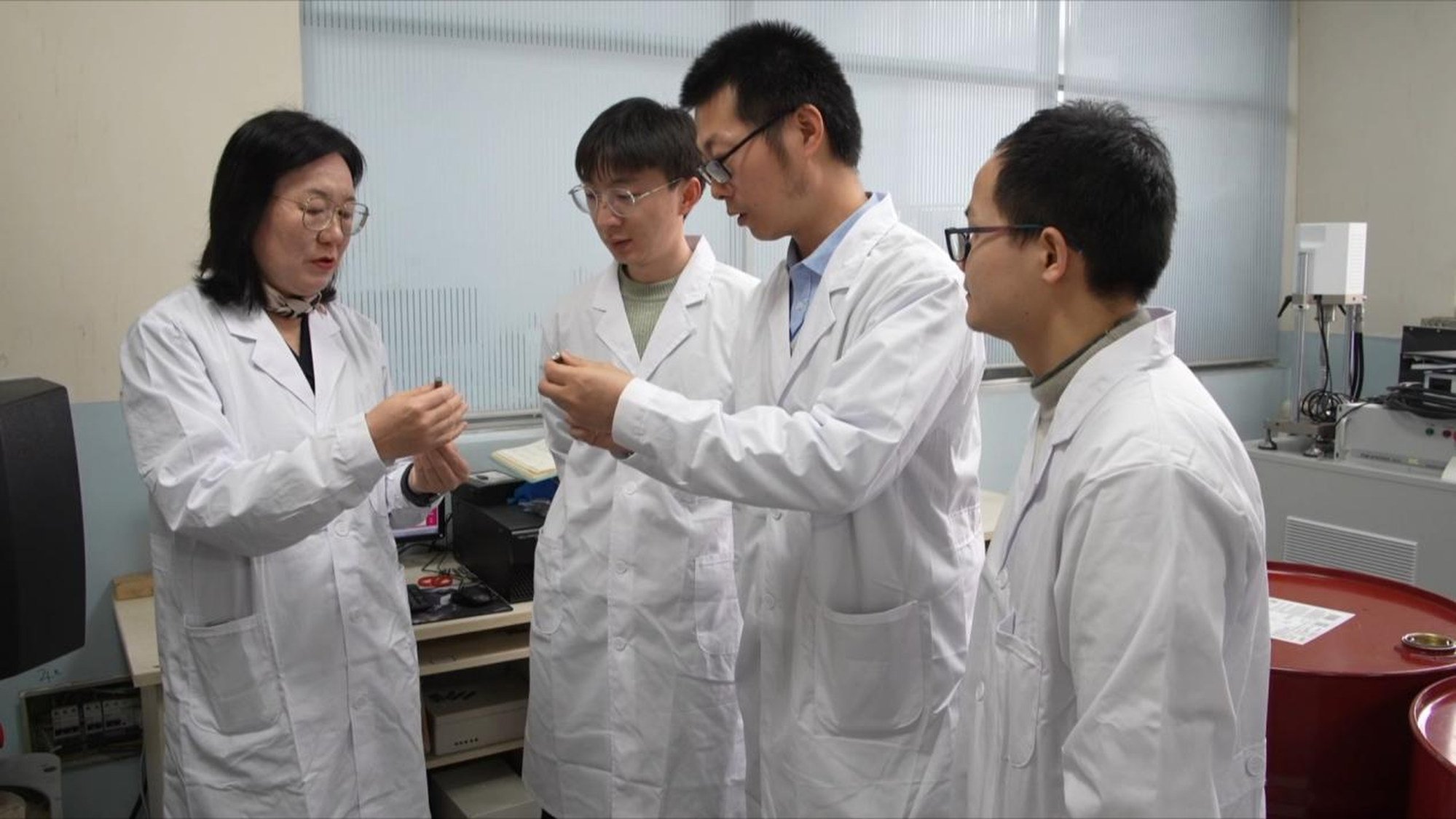
In an interview with state broadcaster CCTV, research team leader Professor Lu Lei said that there was no visible change to the material’s surface before and after processing, but “its internal structure [had] transformed”.
“The skeletal structure is just one three-hundredth the diameter of a human hair, but it plays a significant role when bearing pressure,” she said.
Traditional metal alloys can fracture or shatter under sudden external forces that exceed their yield strength, but they are also susceptible to fatigue when subjected to sustained pressure below this threshold.
Over time, this can cause irreversible deformation as stress accumulates, leading to microscopic cracks, structural warping, and – in severe cases – catastrophic failure without warning.
The phenomenon, known as cyclic creep, typically occurs in materials subjected to high temperatures or stresses over extended periods – such as turbine blades, suspension bridge cables, and the boiler pipes in nuclear reactors, for example.
Increasing the strength of the materials used in these high-stress environments typically compromises their fatigue resistance, presenting a significant challenge to researchers in the field of materials engineering.
Scientists have long sought to minimise the damage caused by creep through a range of developments, including material improvements, structural optimisations, and surface treatments.
Through their innovative redesign of the metal’s crystal structure, Lu and her team have developed a processing method that transforms 304 austenitic stainless steel into a super strong gradient dislocation structure (GDS) steel.
The modification boosts the yield strength by 2.6 times and, compared to other high-strength alloys, increases the cyclic creep resistance by a factor of 100 to 10,000, according to the paper.
The researchers introduced a spatially gradient-distributed, stable dislocation structure within the metal by repeatedly twisting it in a machine. These structures created a submicron-scale, three-dimensional “anti-crash wall” inside the metal, resisting potential damage under external forces.
Through observation by instruments, the team found that these “walls” functioned like springs, absorbing the impact when external forces were applied.
They also triggered denser, finer anti-crash walls when subjected to shock, with the effect that the metal became stronger, the greater the force. The researchers also observed that these secondary reactions occurred uniformly, preventing localised deformations.
Lu’s team specialises in nanostructured metallic materials and has published several related studies in Science since 2018.
This latest achievement not only breaks the theoretical “impossible triangle” in metal materials – where strength, plasticity and stability are traditionally mutually exclusive – but also shows substantial potential for practical applications.
The CCTV report noted that 304 stainless steel, the base material for GDS steel, is widely used and relatively inexpensive.
Its unique structure is primarily introduced through cyclic twisting, a process that requires some investment in equipment but does not need complex high-temperature or high-pressure conditions.
“[That means] this gradient dislocation structure, as a versatile toughening strategy, shows promise in various engineering alloys,” it said.
“It is expected to provide critical support for the long lifespan and high reliability of key components in extreme environments, such as those used in aerospace,” the report added.
More from South China Morning Post:
- Pentagon urges faster militarisation of space, citing China’s advances
- Comac C949: China unveils quiet supersonic jet with 50% longer range than Concorde
- US decouples from China in war on cancer, denying access to research databanks
- Is China’s top-down science strategy driving innovation or killing it?
For the latest news from the South China Morning Post download our mobile app. Copyright 2025.