China is mastering directed energy, radio frequency and other advanced weapon systems that threaten US activities in space, the head of operations for the US Space Force warned on Thursday.
General B. Chance Saltzman, the force’s chief of space operations, told the United States-China Economic and Security Review Commission that China has used its resources more effectively than the US because Beijing is more narrowly focused on one region on the planet, while Washington must manage a larger agenda.
“We just have a much broader set of missions than what we see the PRC focusing on,” he told the commission. “They’re very clear in that they have a Western Pacific mindset.
Do you have questions about the biggest topics and trends from around the world? Get the answers with SCMP Knowledge, our new platform of curated content with explainers, FAQs, analyses and infographics brought to you by our award-winning team.
“They’re able to husband their resources around all the capabilities in that area,” he said, comparing it to China’s rapidly growing maritime ambitions in the Asia-Pacific.
“It’s their focus that allowed them to be the most dangerous and so fast.”
Saltzman contended that the US should hasten the enhancement of Space Force capabilities, and that Washington should regard space less as a resource and more as a military domain.

There are six categories of weapons, he told the commission, and China “is investing heavily in all six categories right now.
“We are not investing in all six categories.”
Those categories, he said, could be further divided into two kinds, ground-based and space-based weapons, with each including the same three types of arms – directed energy weapons, radio frequency weapons and kinetic weapons.
Saltzman said that the US was selectively developing its space arms not only because of limited resources, but also because of an “overly restrictive policy” that hopes to prevent the weaponisation of space.
“Much of our guidance and direction continues to frame space as a strategic resource rather than a war-fighting domain,” Saltzman wrote in his opening statement.
The Space Force budget, he wrote, is “not sufficient to produce the capabilities we need to achieve space superiority”.
“We are critically underfunded in the execution of our newest and most critical mission: space control. We need capabilities both to defeat adversary counters-pace weapons as well as to deny, degrade, or destroy adversary space power.”
Saltzman was not the only Pentagon official testifying on Thursday about a need for Washington to view space as a military domain.
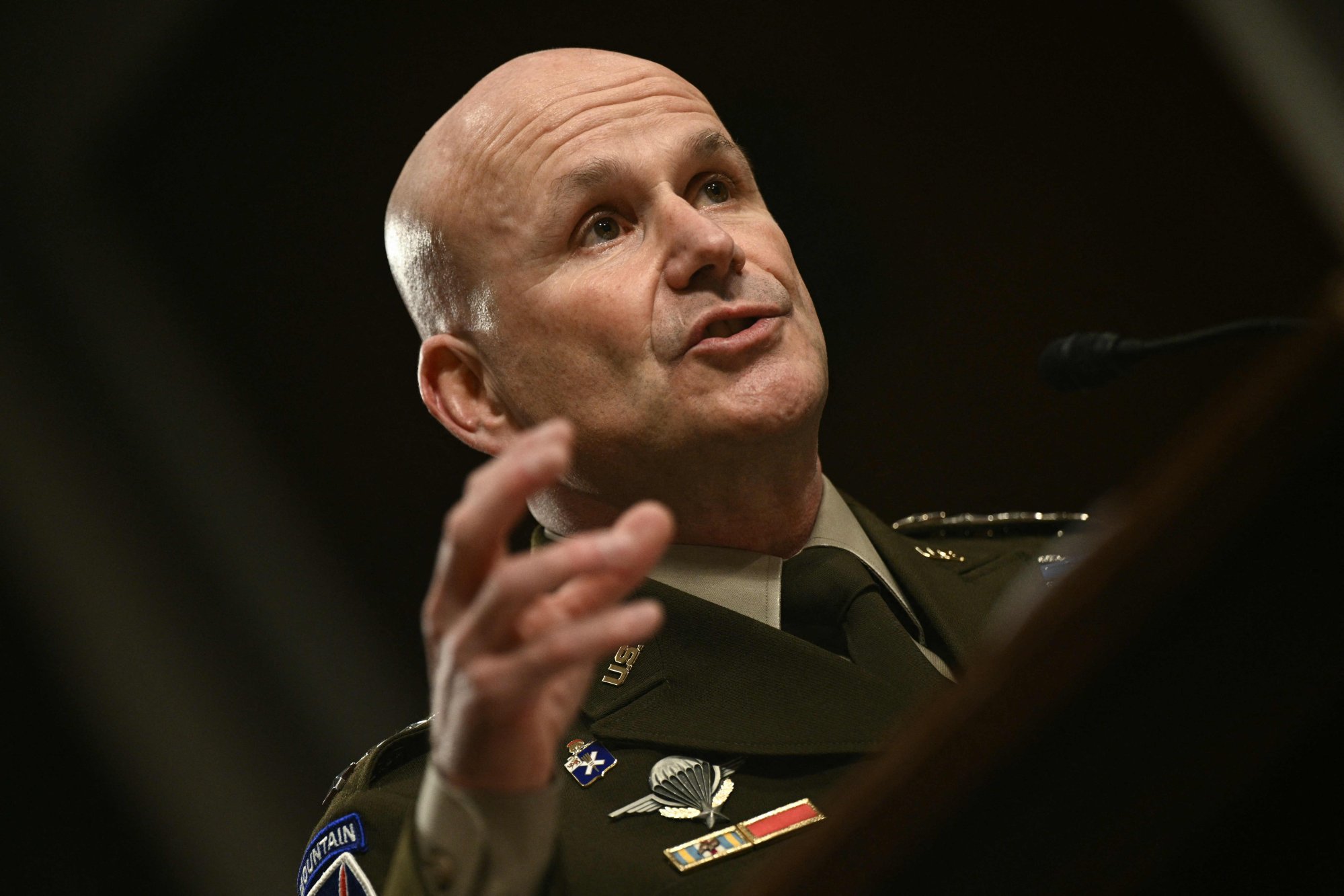
At a hearing before the Senate Armed Services Committee, General Christopher Cavoli, Commander of the US European Command and Supreme Allied Commander Europe, discussed some of the varied geographies into which the new US Space Force’s Europe and Africa division is expanding its footprint.
Since its launch in December 2023, the division had been “building its capabilities” and strengthening its presence across the continents, he said.
“Assets that are strategically tethered in Europe and supported by our allies,” he said, allowed the US to “deliver space effects globally against all our adversaries”.
Cavoli also spoke of growing collaboration with Nato partners. The new division, he said, had “rapidly built relationships with Nato allies to increase allied contributions to our collective security from space-based threats”.
He called it “integral to creating a networked, joint-space architecture” that both protects military space assets and supports global operations.
The US has raised concerns over Beijing’s space programme, arguing that its actions could be offensive. Last month, the US Space Force said that China was practising “dogfighting” after it detected several in-orbit manoeuvres.
In recent years, China has announced a string of ambitious space projects, linked to a drive to achieve the country’s “great rejuvenation” by 2049, with President Xi Jinping calling for China to become a “strong spacefaring nation”.
Last year, China also manoeuvred multiple satellites in close formation, a move that also raised Western concerns about potential military applications.
China has, in turn, accused the US of weaponising space. In December, China’s Ministry of Defence said that the US was “provoking an arms race in space and endangering global strategic security” after a US Space Force unit started operations at Yokota Air Base in Japan.
Ministry spokesman Zhang Xiaogang also said then that China had “always insisted on the peaceful use of space and opposed [its] weaponisation”.
More from South China Morning Post:
- Chinese satellites seen ‘dogfighting’, US Space Force official says
- Chinese nuclear scientists identify flaw in Nasa’s lunar reactor design
- China’s latest satellite launch is a milestone for its commercial space sector
For the latest news from the South China Morning Post download our mobile app. Copyright 2025.