




Former construction contractor Gao Shouguang switched careers last year, abandoning the troubled property sector to become a solar panel distributor – and another example of China’s economic transition – in the southwestern Chinese megacity of Chongqing.
Gao and his team are busy every day, shuttling around the county where they are based to install rooftop solar panels on houses.
Mounted on steel frames, the gleaming striped panels absorb sunlight and generate electricity that can be sold to grid companies, while also shielding the house from rain and heat.
Do you have questions about the biggest topics and trends from around the world? Get the answers with SCMP Knowledge, our new platform of curated content with explainers, FAQs, analyses and infographics brought to you by our award-winning team.
“Solar panels offer waterproofing and can help households earn additional income,” Gao said. “They’re becoming increasingly well-received by farmers.”
Installing solar panels on a typical 100 square metre (1,076 sq ft) rooftop costs more than 100,000 yuan (US$13,700), and that sees most residents opt to rent their rooftop space to solar panel distributors like Gao.
He offers them 25-year contracts that pay 15 yuan per panel a year, plus a first-year incentive payment of 50 yuan a panel. With each solar panel covering about three square metres, the owner of a 100 square metre rooftop can earn around 450 yuan a year.
Solar panel companies can earn an average of about 780 yuan a month by selling the electricity generated by those panels to grid companies, a technician at a power supply station in one Chongqing county said, adding that they purchase the electricity at about 0.39 yuan per kilowatt-hour and distribute it for local use.
As a distributor, Gao can earn about 30,000 yuan from solar panel companies – which covers raw material costs – by installing solar panels on a 100 square metre rooftop.
Gao has entered the growing solar panel industry as China accelerates its renewable energy push. From sun-drenched northern areas to cloudy southern regions, and from large solar farms to the rooftops of houses, factories and airports, solar panels are becoming an increasingly common feature of the country’s energy landscape.
Solar power now makes up 24.8 per cent of China’s total installed electricity capacity, having overtaken wind and hydropower to become the country’s second-largest energy source, China Central Television reported on December 15.
While most solar power is generated by centralised solar power systems – typically large solar farms – “distributed generation” installations on the rooftops of houses, factories and airports are gaining traction.
That wave started in sunlight-rich northern parts of the country, including the provinces of Shandong, Henan and Hebei. Since then, installations have gradually expanded to more southerly coastal regions and, more recently, to areas with the least sunlight exposure, such as Chongqing.
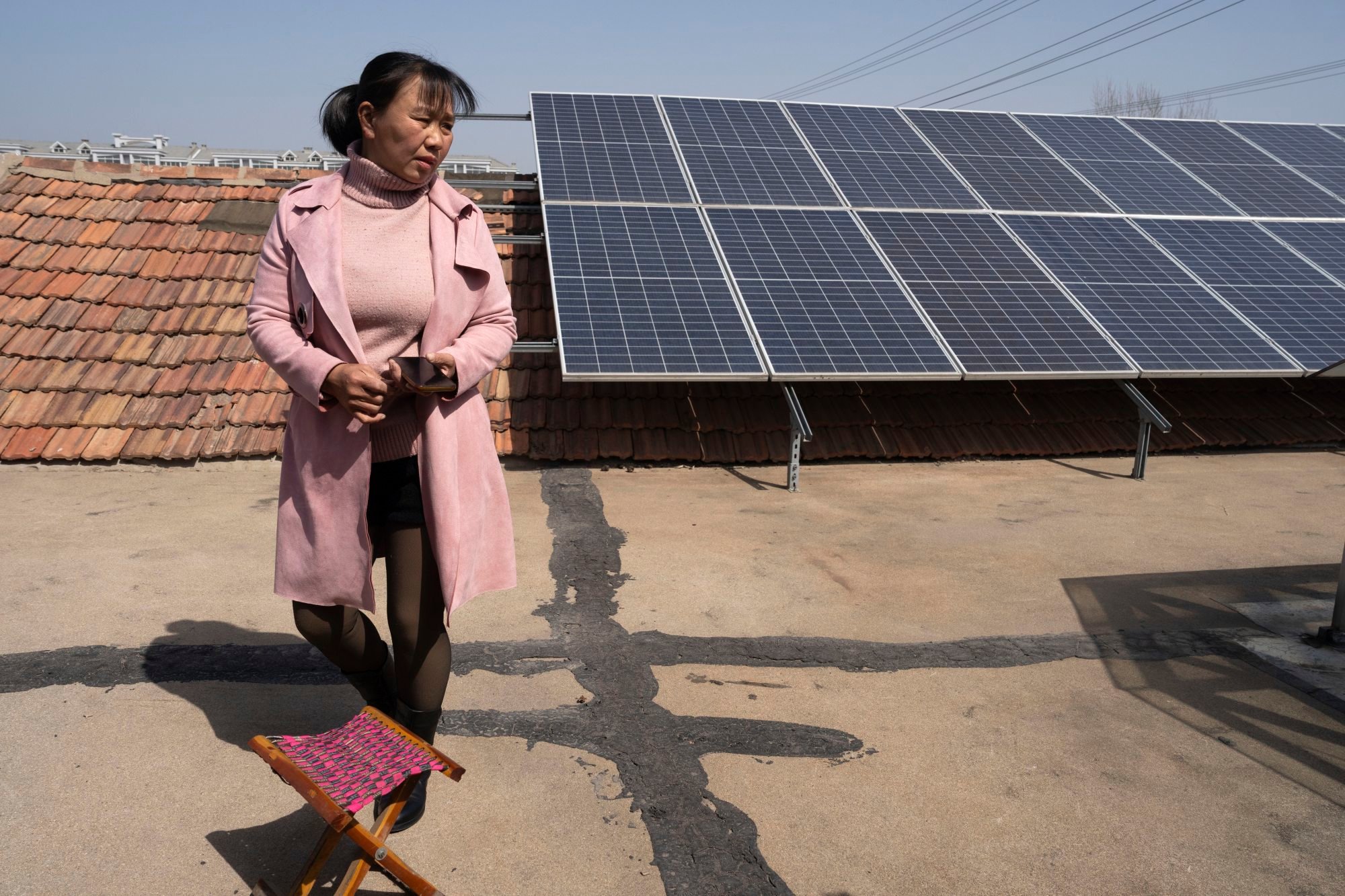
“Studies show that solar power is playing a positive contribution in the reduction of carbon emissions in China, and I think distributed solar panels are a part of this,” said Alfredo Montufar-Helu, head of the China Centre for Economics and Business at The Conference Board think tank.
“This trend will arguably continue strengthening in the future because of policy goals related to increasing energy security and diminishing emissions, but also because, from a cost perspective, it just makes sense.”
Analysts say technological advances and massive production have made solar panels more affordable – with the payback periods required to recover the funds invested in their acquisition via electricity bill savings much shorter than before – helping to spread the benefits of green energy in China.
The development of distributed energy – which includes the use of distributed solar panel systems – was listed as a priority for the first time in this year’s government work report, which was delivered by Premier Li Qiang at the annual meeting of the National People’s Congress in March.
In a guideline issued in 2021, when it started to promote the use of distributed solar panels, the central government said China had a “vast number of rooftops suitable for installing solar power systems, offering significant potential for clean energy development”.
“Installing rooftop solar panels can help integrate resources, reduce peak electricity loads, and save grid costs,” it said. “This initiative is key to achieving carbon neutrality and rural revitalisation.”
The cumulative capacity of installed distributed solar panels rose to 254,400 megawatts last year, up 61.4 per cent year on year, according to data from the National Energy Administration (NEA). The capacity of panels installed on houses exceeded 115,000 megawatts – equivalent to about five Three Gorges Dam power stations.
With solar power becoming a major player in China’s energy mix, the industry’s value rose to 1.75 trillion yuan last year and it provided jobs for around 2.46 million people, according to a report in China Energy News, which is affiliated with the Communist Party mouthpiece People’s Daily, which said it is expected to employ more than 3.3 million people next year.
In late November, the largest distributed solar power project at a civil airport was launched in Chongqing. The 30 megawatt project, being installed on the rooftop of a car park near the terminal, is expected to generate 24 million kWh of electricity a year and meet 10 per cent of the airport’s power consumption needs, according to Chongqing’s municipal government.
Fuelled by strong incentives provided by local governments – such as subsidies and tax breaks – and falling costs, solar panels are becoming an increasingly economical choice for businesses. They are now widely installed on the rooftops of factories and commercial buildings, allowing companies to generate their own electricity and lower their energy expenses.
In June, Guangdong’s provincial government announced that companies installing rooftop solar panels would be exempt from income tax for three years, and local governments in Sichuan province, Chongqing and Beijing have introduced subsidies to encourage the installation of distributed solar panels by businesses.
According to the NEA, over 50 per cent of the distributed solar panels installed last year were dedicated to commercial use. In the first three quarters of this year, the share of solar panels installed for commercial purposes rose to 73.2 per cent, according to data from the China Photovoltaic Industry Association.
Apart from the impetus provided by China’s green goals of seeing carbon emissions peak by 2030 and achieving carbon neutrality by 2060, analysts also attributed the quick expansion to the solar panel industry’s increased production capacity.
“There has been a massive capacity being built up,” said Gary Ng, a senior economist at Natixis. “Companies are struggling to sell their products to other provinces with weaker solar resources, so selling distributed solar panel projects is their way to survive.
“Also, there’s a stronger push towards renewable energy on the policy side, so some of the provinces may feel the need to step up support for rooftop solar panel installations.”
The nation’s varied geographical conditions and seasonality factors have been challenges for developing renewable energy.
“China still faces challenges in providing electricity generated from renewable resources through its national grid across the entire country, largely because the distribution of natural resources is unequal,” Montufar-Helu said.
And with local grid infrastructure facing challenges in accommodating the electricity generated by distributed solar panels, concerns persist about their effectiveness in alleviating electricity shortages.
Despite a continuous increase in total solar power capacity, utilisation, measured by the average operating hours of solar devices, declined this year. In the first four months of the year, installed capacity rose by 36.6 per cent year on year, while average operating hours fell by 17 per cent, according to the NEA.
Dennis Ip, Daiwa Capital Markets’ regional head of power, utilities, renewables and energy storage systems research, said “renewable energy is oversupplied, as the curtailment rate is going up in China”.
Curtailment is a reduction in output due to insufficient grid capacity or demand.
Ip said China’s insufficient grid capacity had negative implications for the development of distributed solar panels because many regions were unable to connect rooftop solar panels to the grid, preventing them from generating revenue through electricity sales.
The government released a draft policy for public comment in October that would encourage high-capacity commercial solar projects installed on factory or school rooftops to increase their consumption of the energy they generated by limiting their grid uploads.
The problem of grid capacity limitations was also highlighted by Gao, who said they had led solar panel distributors to compete by offering high rental rates to homeowners. As a result, their profit margins had shrunk, with installation crews of five people earning only a few thousand yuan each time they completed a household installation.
“We’re now in a ‘bidding war’, as it’s impossible to install solar panels on every household due to limited grid capacity,” he said. “The profit margin is quite slim, but still, it’s better than the days in the construction business.”
More from South China Morning Post:
- US dims Southeast Asia detour for China’s solar products with anti-dumping tariffs
- China warns overheated solar industry to cool the competition, curb backlash
- China’s solar firms eye ‘self-salvation’ amid burning rivalry, growing threats
- China urges solar firms to find global partners to navigate tariffs, trade tensions
- China’s solar industry urges tougher rules to curb overcapacity, price war
For the latest news from the South China Morning Post download our mobile app. Copyright 2024.


