Environmentalists fear Indonesia's food estate programme may destroy forests


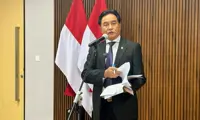
President Joko Widodo (centre), sugar factory PT Prima Alam Gemilang owner Andi Syamsuddin Arsyad (left) and former agriculture minister Amran Sulaiman (right) visit a sugar cane plantation in Bombana regency, Southeast Sulawesi on Oct. 22, 2020. (Presidential Press Bureau/File)

JAKARTA (the Jakarta Post/ANN): The latest regulation issued by the Environment and Forestry Ministry that allows forests to be converted into farmland to support the government’s food estate programme has sparked concerns of potential massive deforestation, according to the Indonesian Forum for the Environment (Walhi).

The ministerial regulation on forest re-designation for food estate development, signed by Minister Siti Nurbaya Bakar on Oct 26, allows forests to be converted into farmland in both protected and production areas.

"The issuance of this ministerial regulation has shown the ugly side of the food estate programme. It would accelerate deforestation in our country and damage the environment," WALHI executive director Nur Hidayati said in a statement on Monday (Nov 16).

Article 19 of the ministerial regulation stipulates that protected forest zones can be converted into Forest Zones for Food Security (KHKP) as long as the forest does not entirely function as a protected forest.

Ministers, governors, heads of state bodies, regents and mayors can request a permit from the Environment and Forestry Minister to convert both production and protected forests into KHKP.

Permits for KHKP management can last for 20 years and can be extended based on the evaluation result of the area utilisation.

The new regulation would also increase the risk of land conflicts between big corporations and local farmers as the regulation did not include agricultural schemes for the latter, Nur argued.

She expressed doubts over the success of the food estate programme, citing the failure of a similar programme during the administration of former president Soeharto.

In the mid-1990s, the former strongman's administration sought to develop a food estate project called the One Million Hectare Peatland Project (PLG) comprising around 1.4 million ha in Central Kalimantan.

President Joko "Jokowi" Widodo's administration is reported to be using some of the former PLG land to develop its food estate.

"PLG, which cost the country Rp 1.6 trillion [US$113.24 million), failed to make [the converted forests] into the national food barn. Instead, some of the PLG areas were converted into oil palm plantations, and remain as such even now," Nur said.

"Ironically, the money used for financing the project was taken from the country's reforestation funds," she added.

Jokowi's administration launched its food estate programme involving the development of around 164,600 hectares of land in Central Kalimantan and 61,000 hectares of land in North Sumatra as part of its National Strategic Projects for the 2020–2024 period.

The food estates are to be developed for crops such as rice, potatoes, shallots and garlic. The government asserted that food estates were essential as the Covid-19 crisis has aggravated Indonesia’s food security issues.

The projects were also aimed at overcoming food distribution issues across the archipelago, land use change, especially in Java, and the increase of the country’s population. In late April, a month after the outbreak in the country, Jokowi reported that key commodities, such as garlic, sugar, chili and chicken eggs, were in short supply in more than 20 provinces, while rice, a staple food for Indonesians, was lacking in seven provinces.

The World Food Program’s (WFP) Indonesia office has estimated that the country experienced a 13.2 per cent year-on-year decline in rice production to 16.1 million tonnes in the first half of 2020.

The issuance of the regulation came amid criticism from environmentalists on the recently passed Job Creation Law, which relaxes rules on environmental protection.

"After the passing of the Job Creation Law, the ministerial regulation would accelerate nature exploitation and deforestation in the country even more," Nur further said.

Officials from the Environment and Forestry Ministry did not immediately respond to The Jakarta Post's request for comments. - The Jakarta Post/Asia News Network

Get 20% OFF The Star Digital Access

Monthly Plan

RM 13.90/month

RM 11.12/month

Billed as RM 11.12 for the 1st month, RM 13.90 thereafter.

Best Value

Annual Plan

RM 12.33/month

RM 9.87/month

Billed as RM 118.40 for the 1st year, RM 148 thereafter.

Follow us on our official WhatsApp channel for breaking news alerts and key updates!
Indonesia , Walhi , environment , food estate , forests

Others Also Read