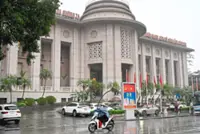
BEIJING: China’s financial sector faces bubble risks, a government official warned on Thursday and said a property tax may be on the cards in the near future as authorities extended their efforts to reduce a worrisome build-up of debt in the economy.
The ratio of China’s financial sector to the overall economy “is the highest ratio in the world,” said Huang Qifan, deputy chairman of the economic and finance committee under the National People’s Congress, China’s largely rubber-stamp parliament.
“This is not a good thing,” Huang told a finance forum.
China’s financial sector as a share of gross domestic product was 8.5% in the first nine months of this year.
The government is in the second year of a crackdown on speculative investment and high corporate debt levels as it looks to defuse financial risks and a property bubble.
Authorities have been particularly concerned about speculative financing and have taken a hard line against risky, shadow banking activities.
Progress, however, has been mixed as policymakers walk a tight rope in trying to reduce China’s years long addiction to debt without shattering economic growth.
Borrowing rates have risen slightly and M2, or broad money supply, growth slowed to a record low of 8.8% year-on-year in October. But credit continues to expand faster than GDP and consumer debt is rising very rapidly.
“M2 in the United States is 70% of GDP, ours is over 200%,” said Huang. “The excessively high M2 leads to inflation, primarily reflected in housing prices, which have risen about eight-fold in the past 10 years.”
Huang said a property tax could be on the cards in the next few years, adding that it will help temper speculation in a sector that has drawn a raft of government curbs in the past year.
China has been discussing a recurring property tax for years, but public progress on the initiative ground to a halt after a very limited pilot scheme was rolled out in 2011.
“I believe (a property tax) will happen in the near future, not take 10-20 years. It could happen in the next several years,” he said.
Huang, appointed to his current post in February, is considered a leading financial expert in China and is best known for his term as mayor of Chongqing.
He also weighed in on how China manages its massive pile of foreign exchange reserves, which rose to US$3.109 trillion in October.
“China has reached a stage where the foreign exchange reserves system must be reformed,” Huang said, adding that the Ministry of Finance should play a bigger role in managing the country’s foreign reserves.
The reserves currently are primarily managed by the central bank, the People’s Bank of China.
Huang said China’s forex reserves can currently only be invested in liquid foreign debt, which generates low returns.
“We want to be a true financial power. To be a financial power, we should not lend more money to other countries, but invest globally and have high and sustainable returns.” - Reuters
Already a subscriber? Log in
Play, subscribe and stand a chance to win prizes worth over RM39,000! T&C applies.
Cancel anytime. Ad-free. Unlimited access with perks.